A softer jawline or loose skin beneath the chin can change how your face looks, even when you have very few wrinkles. You might notice that your cheeks look less firm, or that the skin on your neck no longer sits as smoothly as it once did.
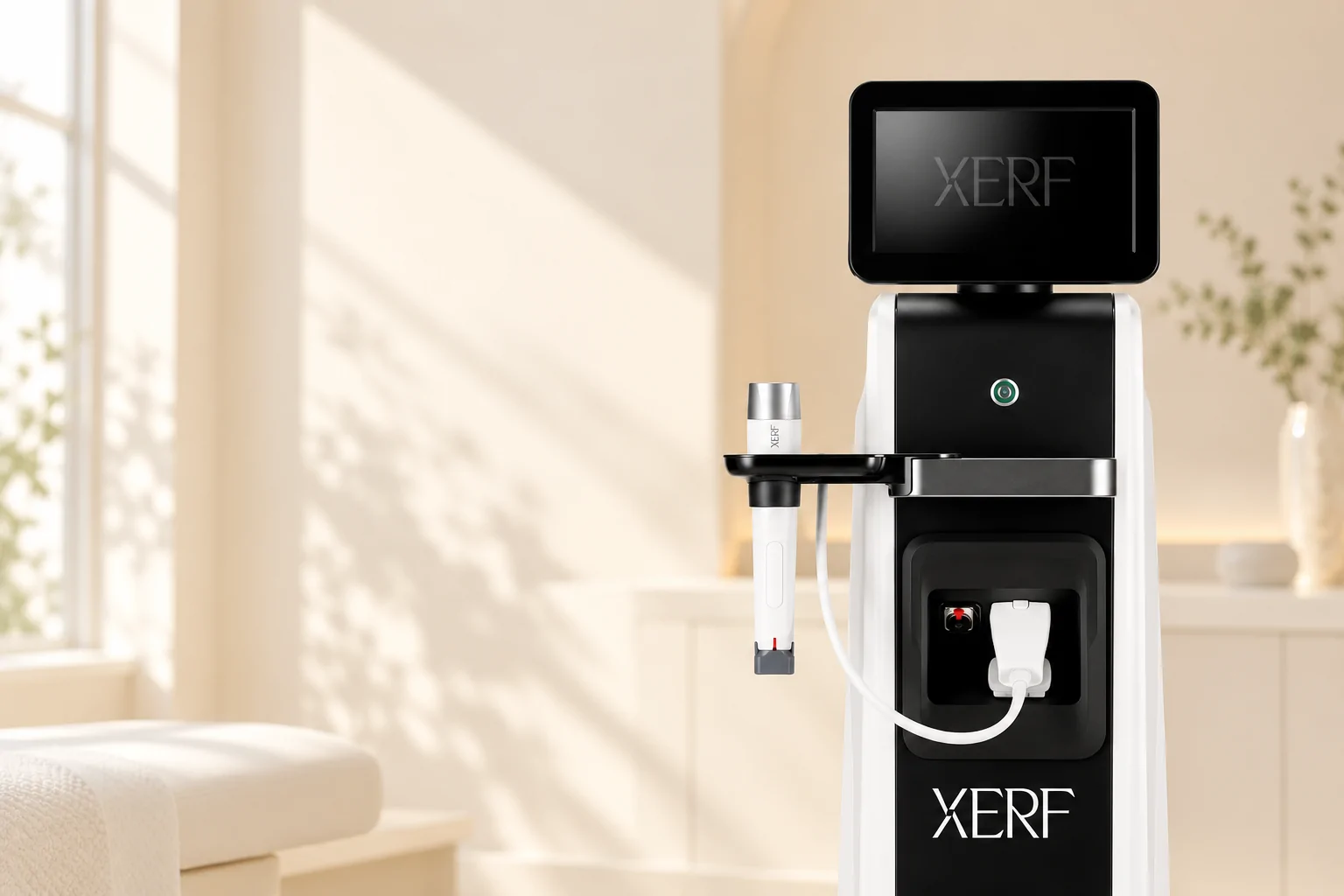
XERF is a non-invasive radiofrequency treatment designed to improve skin firmness without needles or surgery. Rather than adding volume, it uses controlled heat to encourage changes in the collagen that helps support the skin.
You may have first heard about XERF through Kim Kardashian, who shared her treatment experience on Instagram. Her post brought wider attention to the device, but the questions that matter when considering treatment are more personal: what is causing your skin to look loose, and how much improvement can a non-surgical treatment realistically offer?
What Is XERF?
XERF is a dual-frequency monopolar radiofrequency device developed by Cynosure Lutronic. It delivers 6.78 MHz and 2 MHz energy through a handpiece placed against the skin.
In practical terms, this allows the clinician to work at different tissue depths and adjust treatment to the area being treated. The forehead, cheeks and neck have different characteristics, so they do not necessarily need the same settings.
The system combines adjustable treatment depths with cooling and feedback technology to help manage energy delivery. Despite sometimes being called a “XERF laser”, it is a radiofrequency device, not a laser.
How Does XERF Skin Tightening Work?
Collagen helps give skin its strength and structure. As its organisation changes with age, skin can become less firm and begin to drape differently over the tissues beneath it.
XERF delivers energy that produces controlled heating below the surface. The intention is to create an initial tightening response and support collagen remodelling over time. This helps explain why an early feeling of firmness and the later treatment result may be different.
Changes can continue to develop over the following weeks and months. The degree of improvement varies, and the treatment should not be expected to reproduce a surgical facelift.
Which Areas Can XERF Treat?
XERF can be considered for the face and neck, including the cheeks, jawline, under-chin area, forehead and brow region. Treatment must stay within the appropriate applicator’s approved use and be adapted to the anatomy of each area.
Cheeks and Lower Face
When the cheeks lose firmness, the lower face may look heavier or less defined. Treatment in this area focuses on skin laxity.
However, a hollow cheek and a loose cheek are different concerns. Tightening treatment does not replace lost volume, so someone with facial hollowing may need a different approach.
Jawline and Early Jowls
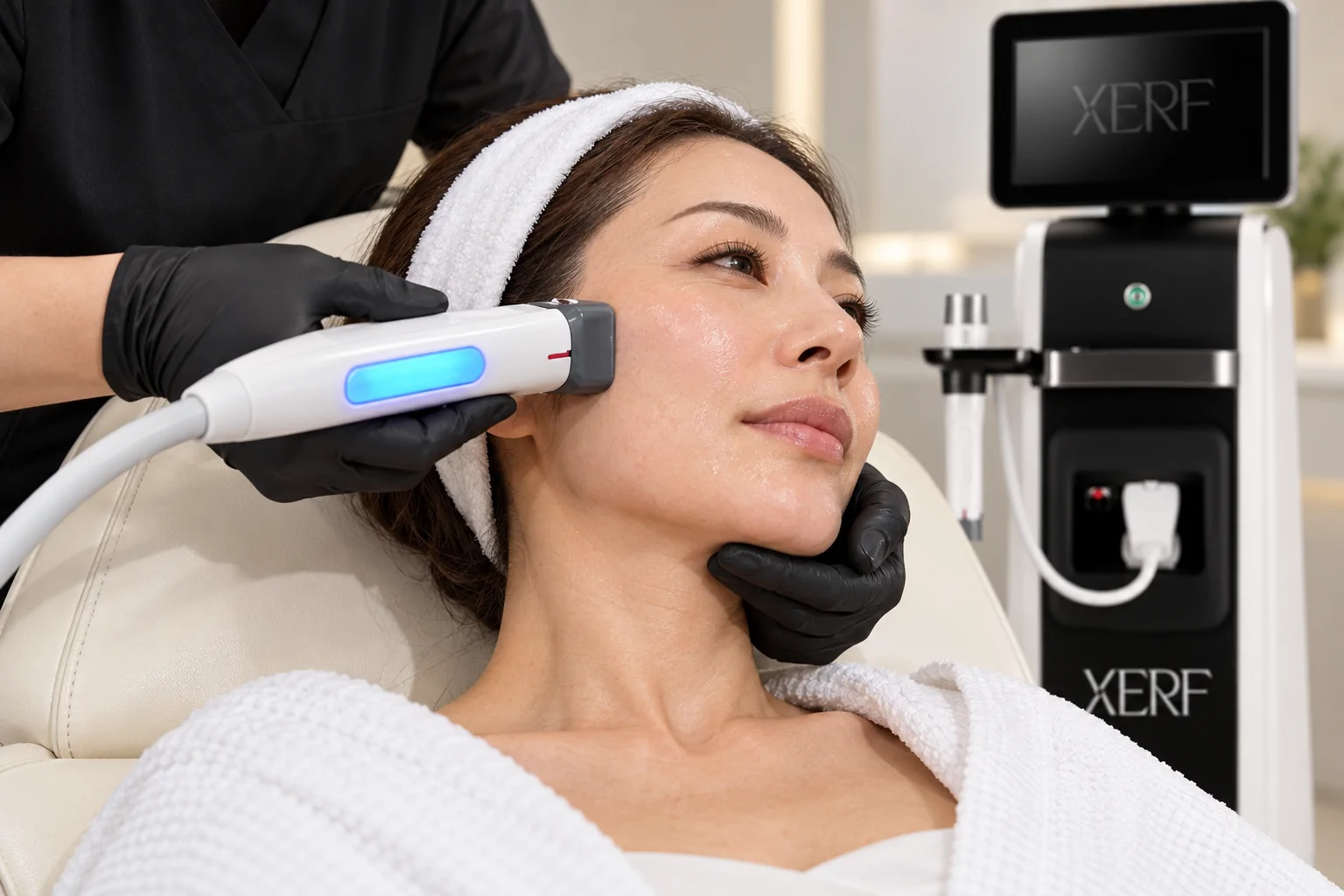
Small folds beside the chin can interrupt the outline of the jaw. These are often described as early jowls.
The aim is to improve the appearance of laxity along this border. If there is substantial tissue descent or excess skin, the change achievable without surgery may be limited.
Under the Chin
A double chin can involve loose skin, fat, chin projection or a combination of these factors. Identifying the cause matters more than choosing a device first.
XERF may be considered when skin laxity contributes to the appearance. It should not be presented as equivalent to liposuction or as a guaranteed way to remove under-chin fat.
Neck
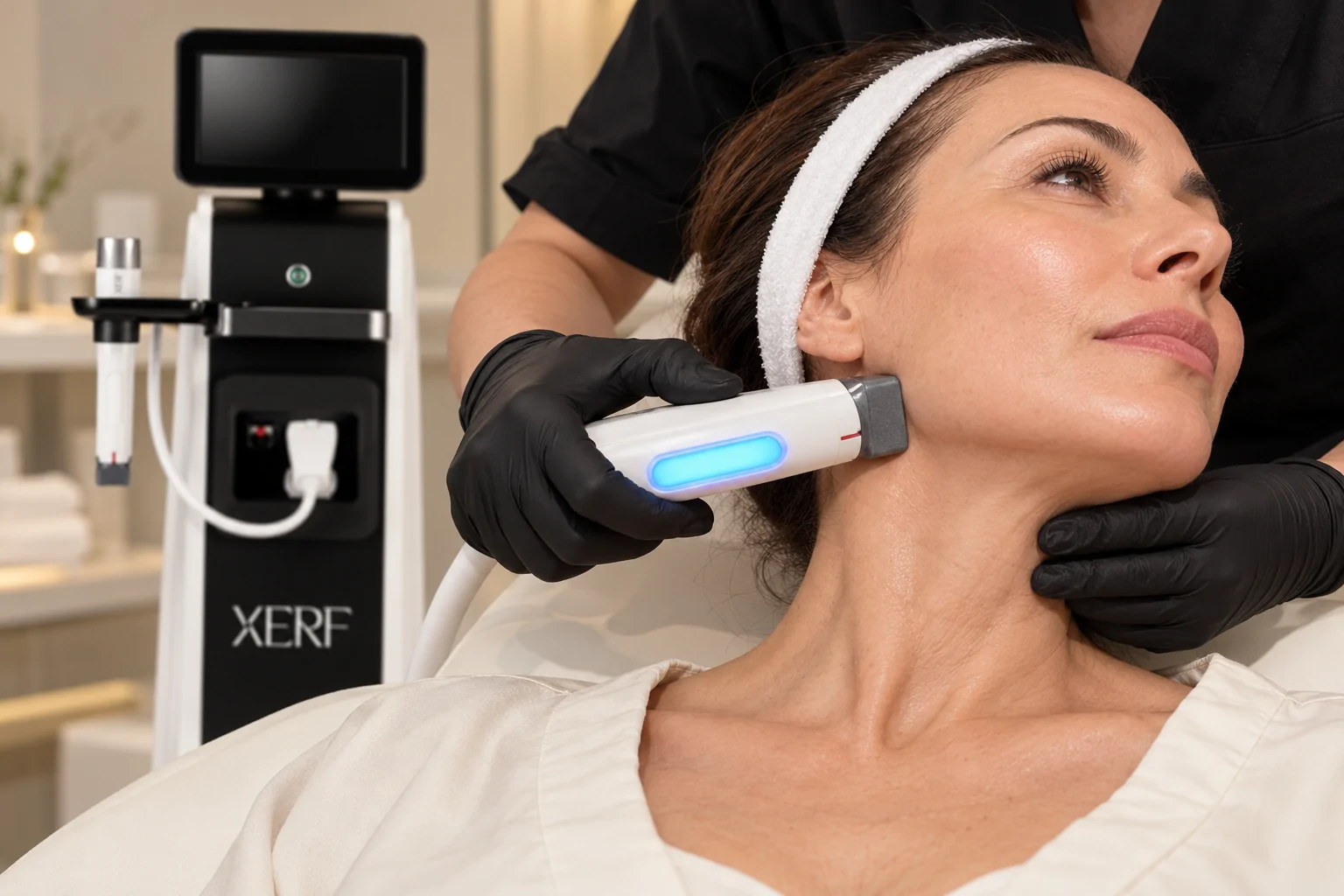
Loose neck skin can make the transition between the face and neck look less distinct. A tightening treatment may be considered for suitable patients, but pronounced skin excess and visible muscle bands need separate assessment.
Forehead and Brow
Treatment around the forehead and brow requires careful attention to anatomy and applicator selection. A modest improvement in firmness is a different goal from removing excess upper-eyelid skin or performing a surgical brow lift.
| Treatment area | Main concern | What to keep in mind |
|---|---|---|
| Cheeks and lower face | Reduced firmness and loose skin | Skin tightening does not replace lost facial volume. |
| Jawline | Early jowls and a less defined facial outline | Significant sagging may require a surgical assessment. |
| Under the chin | Skin laxity beneath the jaw | Fat accumulation and chin structure must also be assessed. |
| Neck | Loose skin and reduced firmness | Excess skin and prominent muscle bands may need other treatments. |
| Forehead and brow | Selected concerns involving mild laxity | Treatment depends on anatomy and the appropriate applicator. |
What Happens During an Appointment?
The appointment begins with an assessment of your skin, facial volume and areas of concern. Previous fillers, threads, surgery and energy-based treatments should be discussed before a plan is made.
During treatment, the clinician places the handpiece against the skin and treats the selected areas in sections. The settings can change between areas rather than following one identical pattern across the whole face.
You may feel warmth and intermittent discomfort. Integrated cooling is designed to make treatment more comfortable, and numbing cream is not routinely required according to the manufacturer. This does not mean that every patient finds the procedure painless.
What Results Can You Expect?
The intended change is a firmer appearance, rather than a completely different face. Early tightening may be noticeable, while later changes develop more gradually.
Published clinical research has reported improvements in facial laxity and skin quality. However, the evidence is still developing. One retrospective study assessed just 16 women, so its findings cannot establish how every patient will respond or reliably identify uncommon complications.
Consistent photographs are useful for reviewing progress. Differences in lighting, head position and facial expression can otherwise make small changes difficult to judge.
Recovery and Possible Side Effects
XERF is generally described as a treatment with little interruption to daily activities. Temporary redness, warmth, tenderness or swelling may still occur.
Non-invasive does not mean risk-free. Burns and unwanted tissue effects are possible concerns with energy-based treatment, making appropriate settings and clinical assessment important.
Follow the aftercare instructions provided for your skin. Contact the treating clinician if you develop blistering, worsening pain or a reaction that is more pronounced than expected.
Why the Original XERF Device Matters
XERF is a specific branded system, not a general name for radiofrequency facials. Another RF treatment should not be assumed to use the same technology.
Before booking, ask which device will be used and who will perform the treatment. If authenticity is unclear, request confirmation through the manufacturer or its local representative using the device’s identifying information.
Authenticity, maintenance and practitioner training all matter. None of them, individually, guarantees a particular cosmetic result.
XERF Treatment Cost in Istanbul
XERF treatment cost depends on the areas included and the number of sessions planned. A limited jawline treatment and a full-face-and-neck appointment are different treatment scopes.
When comparing quotations, check whether the price covers one session or a course, which areas are included and what follow-up is provided. Prices published by overseas clinics should not be treated as a quotation for treatment in Istanbul.
If you are travelling, discuss the proposed schedule before booking flights. A treatment course may require appointments on separate visits.
Frequently Asked Questions
How many XERF sessions will I need?
The manufacturer’s EMEA information describes an initial approach of two sessions, approximately four to six weeks apart. Your clinician may recommend a different plan depending on your skin and goals.
How long do XERF results last?
Results are not permanent because skin continues to age. Maintenance should be based on reassessment rather than a promise that every patient’s result will last a fixed number of months.
Does XERF melt facial fat?
It should not be chosen as a guaranteed fat-removal treatment. Existing facial volume and tissue thickness need careful assessment, particularly in a naturally lean or hollow face. No energy-based procedure should be described as carrying zero risk of unwanted tissue effects.
Is XERF better than Thermage or Ultherapy?
There is no single best device for every face. XERF’s dual-frequency RF technology does not, on its own, prove better clinical results than another treatment. A useful comparison considers your anatomy, the concern being treated and the evidence for each option.
Can I have XERF after fillers?
Tell your clinician which products were used, where they were placed and when. Treatment timing should be decided from those details rather than using one waiting period for everyone.
Can XERF replace a facelift?
It does not remove excess skin or surgically reposition descended tissues. For someone with advanced sagging, a facelift consultation may provide a more realistic understanding of the available options.
How is treatment suitability assessed with Dr. Leyla Arvas?
Assessment considers skin laxity alongside facial volume, under-chin fullness and any need for surgery. This helps establish whether non-surgical tightening is a reasonable option and what degree of change is realistic.

Content Responsibility and Medical Review

Medical expert
Specialist in Plastic, Reconstructive and Aesthetic Surgery
Leyla Arvas graduated from Istanbul University, Istanbul Faculty of Medicine in 1998 and is a specialist in Plastic, Reconstructive and Aesthetic Surgery.
Dr. Leyla Arvas sees patients at her private practice and performs her surgeries at Acıbadem Hospital and Memorial Hospital, both of which are accredited by the Joint Commission International (JCI).
Medical content lead for XERF Skin Tightening for Face and Neck: Leyla ARVAS
Last updated:
Sources
- Academic / Scientific Source Cleveland Clinic — Ultherapy
- Medical Authority / Professional Organisation ASPS — How laser and radiofrequency treatments rejuvenate your skin
- Academic / Scientific Source Cleveland Clinic — Radiofrequency (RF) skin tightening